You
You are awake.
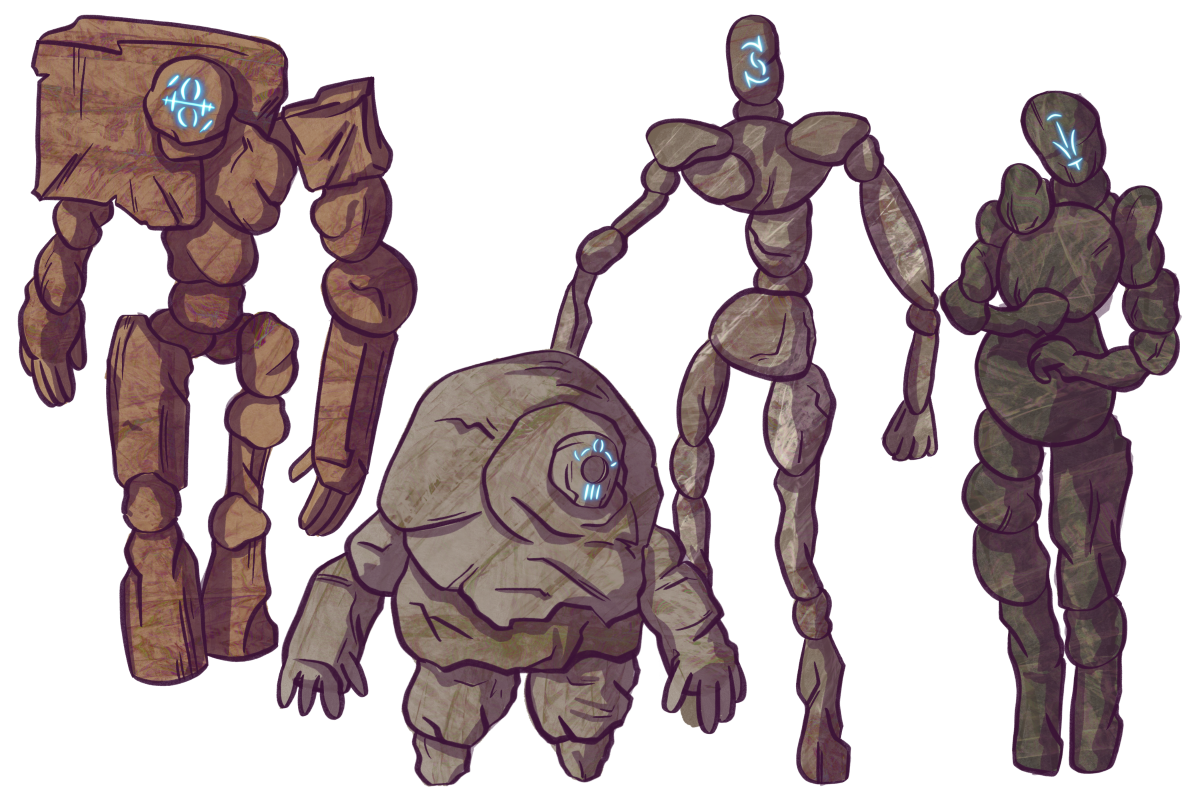
Vision comes slowly, blurry at first, but in the distance you can make out perhaps two dozen grey silhouettes in a vast cavern, illuminated by a faint glow. A few more seconds and their form comes into view: great creatures of stone, perhaps two metres tall, though the precise build seems to vary from figure to figure. An eerie turquoise light emanates from the heads of the figures, though you can't quite make out what it is.
You look at your hands. You, too, are made of stone: smooth, evidently not a product of erosion – though you don't know why you know that – your digits move naturally, gliding without friction in sockets you would expect to grind. Your arms, too, move freely, then your legs, and soon enough you have a full range of motion.
Ideas and knowledge which you have never experienced or learnt now flow inside your head, with their meanings unmistakable. As you turn to face the figures, the thoughts in your mind condense effortlessly into a language. It's a language which others seem to naturally understand.
The glow on their foreheads is clearer now: each has a unique symbol on its forehead, intersecting and overlapping in an oddly familiar geometry. By instinct, you recognise the meanings of the symbols – they're names.
In time, you will discover more about yourself and those around you. The outside world is waiting.
Designing your Character
Character names are based on things or concepts. That could be anything ranging from “Thought” to “Stoic”, or from “Heat” to “Shell”. The characters innately understand words whose origins they do not know, and there is little restriction on what their names might mean. They also have a unary sex, so we recommend that most characters use some combination of “they”, “it” or “any” pronouns (although you are free to use whatever pronouns you are comfortable with).